


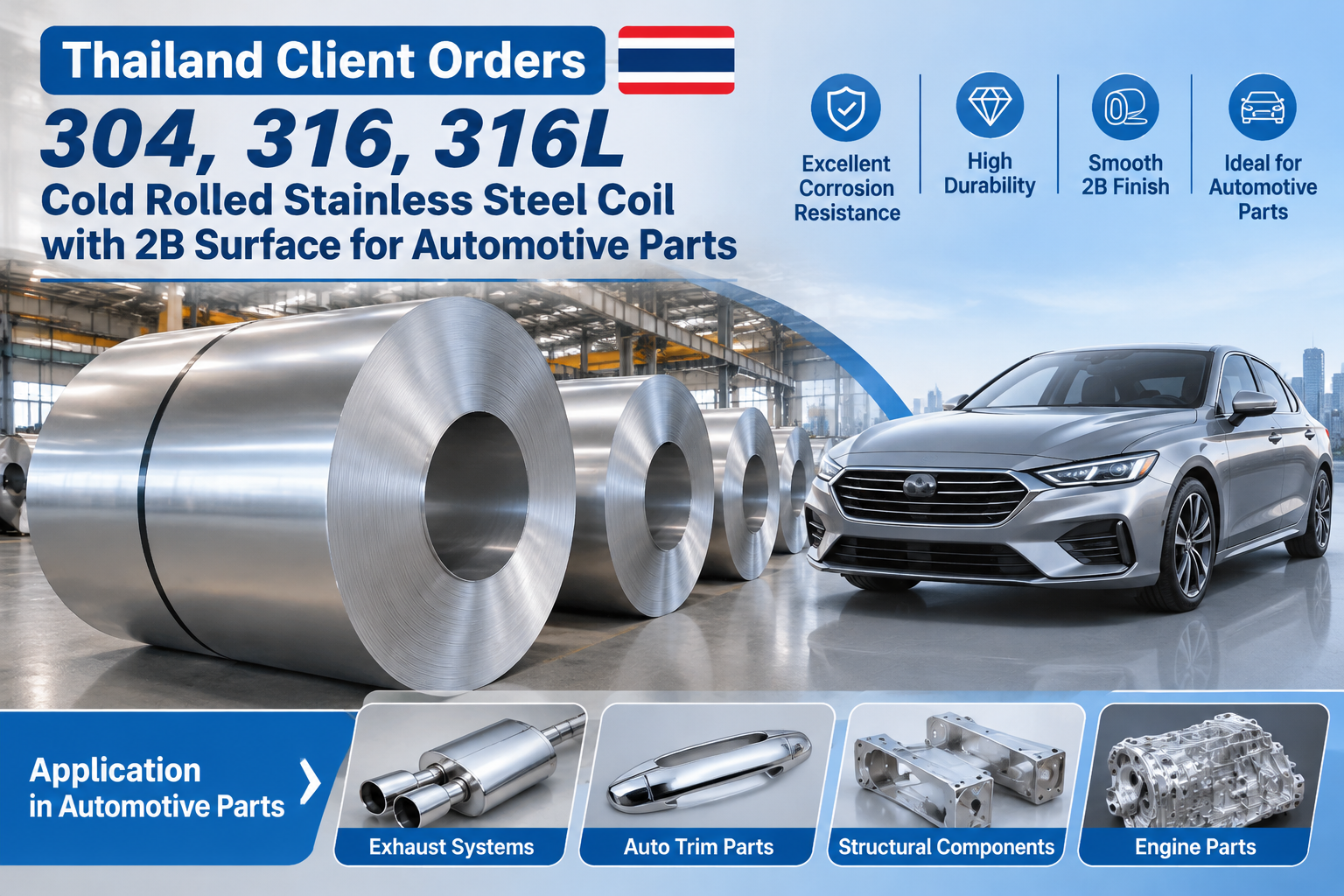
Thailand Client Orders 304, 316, 316L Cold Rolled Stainless Steel Coil with 2B Surface for Automotive Parts
Veröffentlicht am: November 23, 2026
Thailand Client Orders 304, 316, 316L Cold Rolled Stainless Steel Coil with 2B Surface for Automotive Parts
An automotive parts manufacturer on Thailand's Eastern Seaboard placed a repeat order for 304, 316 and 316L cold rolled stainless steel coil with 2B surface. The coil is consumed on continuous stamping and roll-forming lines producing exhaust components, decorative trim, brackets and underbody hardware for vehicle assembly programmes. Wuxi Sylaith Special Steel Co., Ltd. supplied slit coil to width with oiled 2B surface, matched to the client's coil-handling equipment and press line requirements.
Client Background
The client operates as a tier-2 supplier in the Thai automotive cluster around Rayong and Chonburi, feeding both Japanese-brand assembly plants and aftermarket exhaust producers. Their production model is coil-fed rather than sheet-fed: material runs from a decoiler through levelling, stamping and forming stations without manual handling.
The Challenge
- Coil-to-coil consistency: Continuous stamping tolerates almost no variation in thickness, hardness or flatness between coils; inconsistent material means scrap and press downtime.
- Grade matching to application: The client needed three grades in parallel — 304 for general trim and brackets, 316 for road-salt corrosion resistance, and 316L for welded exhaust assemblies where sensitisation at the weld zone is a risk.
- Slit width accuracy: Coil must be slit to the exact strip width used on each tool, with clean slit edges and no burr that would damage dies.
- Formability for deep-drawn and bent parts: Automotive brackets involve tight bend radii, so elongation and springback behaviour had to be predictable run to run.
- Surface condition for stamping: Oiled 2B surface was required to reduce galling and die wear, without oil that would interfere with downstream welding.
- Coil handling compatibility: Inner diameter had to match existing decoiler mandrels, with coil weight within crane and uncoiler limits.
The Solution
We supplied cold rolled stainless steel coil in 304, 316 and 316L, 2B finish, in slit widths from 20 mm up to 1250 mm, with coil inner diameter and unit weight matched to the client's decoilers.
- Grade-by-application supply: 304 for body trim and general brackets; 316 for underbody and road-salt-exposed parts; 316L for welded exhaust sections, where the low carbon content keeps intergranular corrosion resistance intact after welding.
- Precision slitting: Coil slit to strip width with tight width tolerance and deburred edges, protecting progressive dies from edge damage.
- Consistent mechanical properties: Material drawn from controlled heat numbers so yield strength, elongation and hardness stay stable across the whole shipment, keeping springback predictable in forming.
- Oiled 2B surface: 2B finish with a light, weld-compatible oil film to reduce friction and galling in the press, while remaining clean enough for downstream joining.
- Flatness and coil build: Even coil winding without edge damage or telescoping, wrapped with interleaved paper and steel strapping for safe container loading.
- Documentation: Mill test certificate EN 10204 3.1 per heat number, with heat number marked on each coil tag for automotive traceability requirements.
Technical Specifications
| Parameter | Specification |
|---|---|
| Grades | 304 / 316 / 316L |
| Product | Cold rolled stainless steel coil / slit strip |
| Thickness | 0.3 mm – 2.0 mm |
| Width | Slit strip from 20 mm; master coil up to 1250 mm |
| Coil Inner Diameter | 508 mm / 610 mm |
| Coil Weight | 3 MT – 12 MT, adjustable to client handling limits |
| Surface Finish | 2B (annealed, pickled, skin-passed), oiled |
| Edge | Slit edge, deburred / mill edge |
| Standard | ASTM A240 / EN 10088 / JIS G4305 |
| Packing | Interleaved paper, steel strap, eye-to-sky or pallet |
| Inspection | Mill test certificate EN 10204 3.1, heat number per coil |
Grade Selection Guidance for Automotive Applications
| Grade | Why It Fits | Typical Automotive Parts |
|---|---|---|
| 304 | Balanced formability, weldability and cost | Body trim, brackets, clamps, seat frame parts |
| 316 | Molybdenum addition resists chloride and road-salt attack | Underbody hardware, exposed fasteners, coastal-market parts |
| 316L | Low carbon prevents carbide precipitation after welding | Welded exhaust assemblies, manifolds, hot-end components |
Results & Benefits
- Stable coil-to-coil properties reduced press stoppages and scrap rate on the client's progressive dies.
- Accurate slitting meant coils loaded directly onto the decoiler with no re-slitting or edge trimming on site.
- Correct grade assignment eliminated an earlier failure mode where 304 was used in a welded exhaust section and suffered premature corrosion at the weld zone.
- Oiled 2B surface lowered die wear and improved part surface finish without extra cleaning before welding.
- Coil tags and heat-number documentation satisfied the client's automotive traceability audit requirements.
Conclusion
Automotive coil buyers are not buying stainless steel by appearance — they are buying process stability. Consistent gauge, controlled mechanical properties, precise slitting and the right grade in the right application are what keep a stamping line running. Whether the requirement is 304 for trim, 316 for road-salt exposure or 316L for welded exhaust parts, coil supply matched to the decoiler and the die is the difference between a smooth programme and a line stoppage.

